


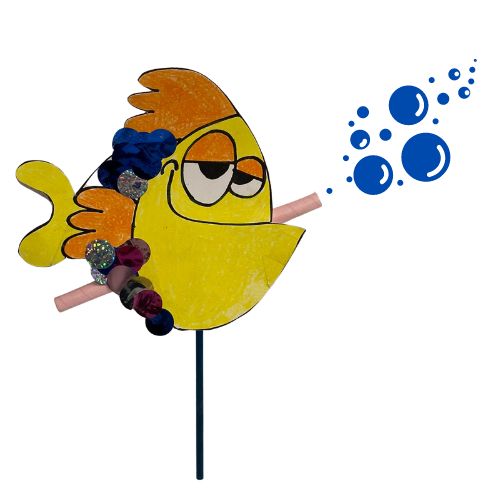
The puppet fish and the owl
From this puppet, a series of respiratory gymnastics activities can be carried out using the snort so that the children have a good control of this function, which is so important for correct phonation.
It's a fish puppet that has a stick attached to its back to blow.
Discovery of the possibilities of the owl:
- We can play to see what happens when we blow several things with the fish: a
the air, against objects, papers, in the water,...
Discovery of the intensity of the puff:
- We open our hands and place them in front of the fish. Let's blow really hard, really hard. Notice the wind on your hands?
- Now let's blow very softly, very softly. Notice the soft air above them
hands?
- Now let's blow hard and loose.
- With a container of water we can try to blow hard and loose.
- If we add soap we can try to make bubbles. What happens if we blow?
strong? And if we blow loose?
Discovery of the position of the lips in the snort:
- Let's blow up and down.
- We can explain to the children that we are going to blow by removing the lower lip and
putting it on top. So, very good! what happens now
Discovery of the force of the blow:
- Through the little fish we are going to blow papers. We put the children in front
from a table with your hands back. Papers are placed on the table
disseminated At a signal each child blows the papers until they leave
clean table
Discovery of the rhythm of the snort:
- Making soap bubbles we can play to see who can hold on longer
bubble in the mouth of the little fish.
- And now, let's see who makes the most bubbles?
Discovery of the directionality of the puff:
- By making soap bubbles, we can try to keep them from falling to the floor by blowing them into the air. Let's see who gets it!!
At MIT we have a sample inside ours Collection of puppets.